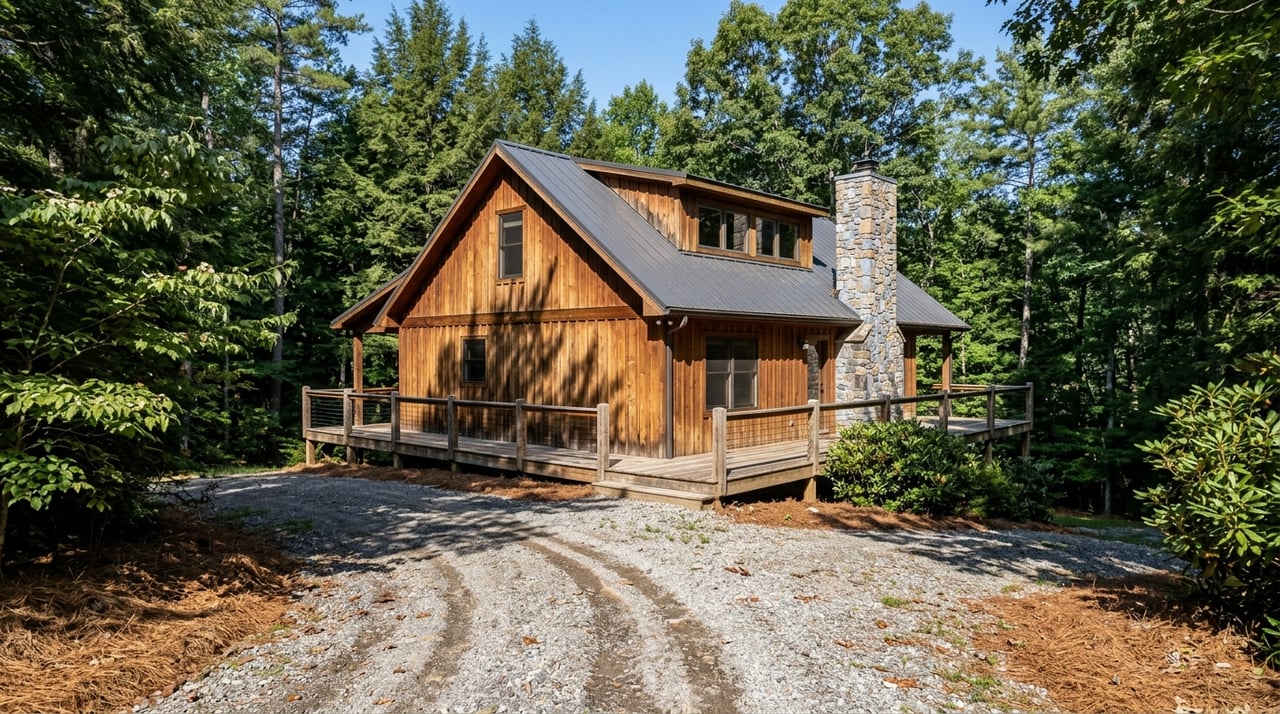
Say you're three weeks from closing on a riverfront cabin outside Andrews. You've done the sensible thing and started building a spreadsheet: nightly rate, cleaning fees, projected occupancy, and the tax bite that comes off the top before any of it hits your account. You search "Cherokee County occupancy tax" to fill in that last line, and you get two different answers from two reasonably credible-looking sources. One says 4%. Another says the rate jumped to 6% back on July 1st.
That's not a hypothetical. That's what I found when I went looking for the same number myself this month, and I've spent enough years doing this to know that when the internet disagrees with itself on a tax rate, the disagreement is usually the actual story worth telling.
Two Numbers, One County
Cherokee County's own government page, the one where owners actually file their occupancy tax reports, states the rate plainly: four percent on gross rent charged, for any accommodation rented less than 90 consecutive days, whether that's a hotel room or a cabin on Valley River. That page also spells out something a lot of first-time hosts miss entirely: the monthly report is due by the 20th of the following month, and you have to file it even in months when you owe nothing. Zero-dollar months still require paperwork.
Elsewhere online, you'll find a claim that this rate already climbed to 6% as of July 1, 2026. I checked the county's own published page again while researching this piece, and as of this writing it still says 4%. So one of two things is true: either that secondary source is simply wrong, or it's describing something that hasn't formally taken effect yet at the source that matters most, the county's own finance office.
I'd put my money on the second explanation, and here's why.
Why the Confusion Is Actually the Interesting Part
There is a real bill sitting in Raleigh right now with Cherokee County's name on it. Senate Bill 953, titled plainly "Cherokee County Occupancy Tax Modifications," was introduced on April 30, 2026, and referred to the Senate Rules and Operations Committee on May 4. It has not, as far as the public record shows, become law. It's pending.
I suspect the 6% figure floating around various rental-tax guides is someone getting ahead of the legislature, treating a bill in committee as though it were already settled policy. It's an easy mistake to make, and it's exactly the kind of mistake that costs an investor real money if their underwriting assumes a rate that isn't yet in force, or worse, doesn't account for one that might be by the time they close.
The lesson isn't which number is right today. It's that the number is genuinely in motion, and the only way to know where it lands is to ask the county directly, not the third listicle Google surfaces.
It's a Tax Problem, Not a Zoning Problem
If your short-term rental education came from reading about Asheville or Charlotte, you probably arrived in Cherokee County expecting a fight over special use permits, resort-zone restrictions, and caps on how many non-owner-occupied units can exist per block. That fight isn't happening here, at least not in the way it plays out in those cities.
Asheville limits whole-home short-term rentals to its Resort zoning district and treats owner-occupied homestays as a separate category entirely, with its own annual permit. Raleigh requires a zoning permit posted on every listing and caps the share of units in a multifamily building that can operate as rentals. Cherokee County's actual compliance gate looks nothing like either of those. It's a tax registration, filed monthly with the Finance Office, full stop. There's no zoning overlay carved out for short-term use, no separation-distance rule between rental properties, no cap on how many cabins can operate on a given road.
That's not the same as saying anything goes. It's saying the friction here is administrative rather than architectural, which changes what you should actually be worried about walking into a closing. You're not fighting a planning board. You're setting up a recurring monthly filing habit and making sure you don't fall behind on it.
What This Actually Does to Your Numbers
Right now, a short-term rental in unincorporated Cherokee County or inside Andrews town limits carries the state's 4.75% sales tax on accommodations plus the county's 4% occupancy tax, for a combined 8.75% off the top of every dollar of gross rental revenue before you touch cleaning fees, platform commissions, or anything else. That's the number that should be sitting in your underwriting spreadsheet as of today.
If Senate Bill 953 moves and the rate does climb toward 6%, that combined burden rises to roughly 10.75%, a jump of two full points on gross revenue. On a property doing meaningful nightly volume, two points is the difference between a deal that pencils and one that doesn't, particularly for buyers running tight margins against a mortgage on a second home. It's not a number that shows up on a listing sheet, and it's exactly the kind of thing that only surfaces once someone starts asking questions the portals don't answer.
The Other Line You Have to Check
There's a second wrinkle specific to Andrews that's easy to miss if you're only thinking about the county. Andrews has its own Planning and Development office and its own Development Ordinance, separate from whatever unincorporated Cherokee County allows outside the town line. In my own digging, I could not find a dedicated short-term rental provision written into the town's ordinance the way Asheville or Raleigh publish theirs. That absence isn't confirmation that anything is permitted. It's confirmation that you need to call Town Hall and ask directly, because the state's own guidance on this is worth understanding too: North Carolina's Vacation Rental Act, the law most guides cite as governing short-term rentals, is a landlord-tenant statute about deposits and written agreements. It has nothing to do with whether your specific parcel is zoned to allow the use in the first place. That question lives entirely with the town or county where your property sits.
So before you close on anything inside Andrews town limits, the property's exact address matters more than any statewide guide can tell you. A cabin two roads apart can sit on opposite sides of that town line, with different governing bodies and potentially different answers to the same question.
A Short Checklist Before You Sign
If you're seriously considering a short-term rental purchase in or around Andrews, here's what I'd actually do before closing, in order:
- Call Cherokee County's Finance Office directly and confirm the current occupancy tax rate on the day you're reading this, not the day I wrote it.
- Ask whether Senate Bill 953 has passed, and if so, what the effective date is for any new rate.
- Confirm with Andrews Town Hall's Planning and Zoning office whether the parcel sits inside town limits, and if so, whether any short-term rental provisions exist in the current Development Ordinance.
- Register for occupancy tax collection before your first guest checks in, using the county's own registration form, not a third-party platform's assumption that they've handled it for you.
- Set a recurring monthly reminder for the 20th, because the filing requirement doesn't pause just because a month was slow.
None of these steps require a lawyer. They require phone calls, and about an hour of your time, and they'll tell you more about the real economics of the property than any rate comparison chart pulled together for a national audience that's never set foot in Cherokee County.
A Few Questions I Get Asked
Does the state sales tax rate change based on where in Cherokee County the property sits? No. The 4.75% state component is uniform statewide. What varies is the local occupancy tax layer, which is set at the county level here.
If Airbnb or Vrbo collects taxes on my behalf, do I still need to register with the county? Generally yes, particularly if you ever take a direct booking outside the platform. The county's registration and monthly filing requirement exists independent of what any booking platform handles automatically.
Is there a cap on the number of short-term rentals allowed in Cherokee County? I found no evidence of a numerical cap in the county's published materials, unlike some coastal North Carolina markets that have adopted waitlists for new permits.
If you're weighing a short-term rental purchase anywhere along this stretch of the Nantahala corridor, I'd rather spend twenty minutes on the phone with you now than have you discover a compliance surprise after closing. I've made the calls to Cherokee County's Finance Office and to Andrews Town Hall more times than I can count, and I'm happy to make them again on your behalf. Reach out to Allison Ralph and let's talk through the specific parcel you have in mind before you sign anything.